Product design · AI customer support
The Handoff
Designing the moment an AI agent steps back.
An AI agent is judged by its last message. When it hands a customer to a support rep, nobody should have to start over.
The AI agent is the bot a customer talks to on a company's help page. The support rep is the person who takes over when it steps back.
Ostrella is invented. No real company's data, screens or customers appear here.
The customer
The support rep
01 · The problem
The worst moment in AI support is the handoff.
At 1:26 a.m., Canada Post's AI agent offered me a person for the fourth time. Each time I said yes, it told me no one was available.
The day before, a person did join Square's chat. Their first words were “How can I help you today?”, although Square's help page says the context is passed on.
Intercom's own AI agent passed me to a person, who opened with “How can I be of assistance?” while my last question sat right above it, unanswered.
By the time a customer reaches a person, they've already explained the problem once. A vague handoff makes them do it again:
- The support rep
- opens mid-queue, often on a customer who's already angry, and has to ask.
- The customer
- has spent their patience on the AI agent, and has to answer.
Five companies say on their own pages what their support rep receives: a chat history, a summary, “context”. None says what the customer sees before it's sent, or lets them correct it.
02 · What I saw
Too soon or too late, the handoff fails for the same reason: the AI agent hasn't understood the problem.
- 5
- Interviews with support and customer success people, 2 to about 9 years in the field
- 5
- AI support agents read from their companies' own pages, dated: Clio, GoDaddy, Square, Wealthsimple, Claude
- 3
- Live runs as a real customer: Square, Canada Post after hours, and Intercom's own Fin
- 7
- Field notes from about four years in customer support and success
Field notes: from my own experience. No employer data, screens or ticket text.
Only the re-asked problem is waste.
Two reps re-asked the problem itself, because the handoff was vague. Three re-checked details on purpose: an email, account and money details, the action before a cancellation. Checking isn't waste. It can be one readback the customer confirms.
“The AI was just very brief and sort of looked incomplete.”
The handoff is read twice.
All five want a few lines, not the transcript. Three build their first reply from it. So a wrong summary ends up wrong in front of an angry customer.
“If they know what's going on, they take a back seat and they calm down.”
Understanding is the trigger, not timing.
All five described a handoff that came too soon, and one that came too late. Both failed the same way: the AI agent stepped back, or kept going, without understanding the problem.
What surprised me I expected reps to resent re-asking. Three of five do it on purpose.
03 · One moment, two sides
The handoff is read twice. So the customer sees it, and can correct it, before the rep does.
The customer's last minute with the AI agent and the rep's first minute are one moment. Each decision below names its cost.
The customer's side
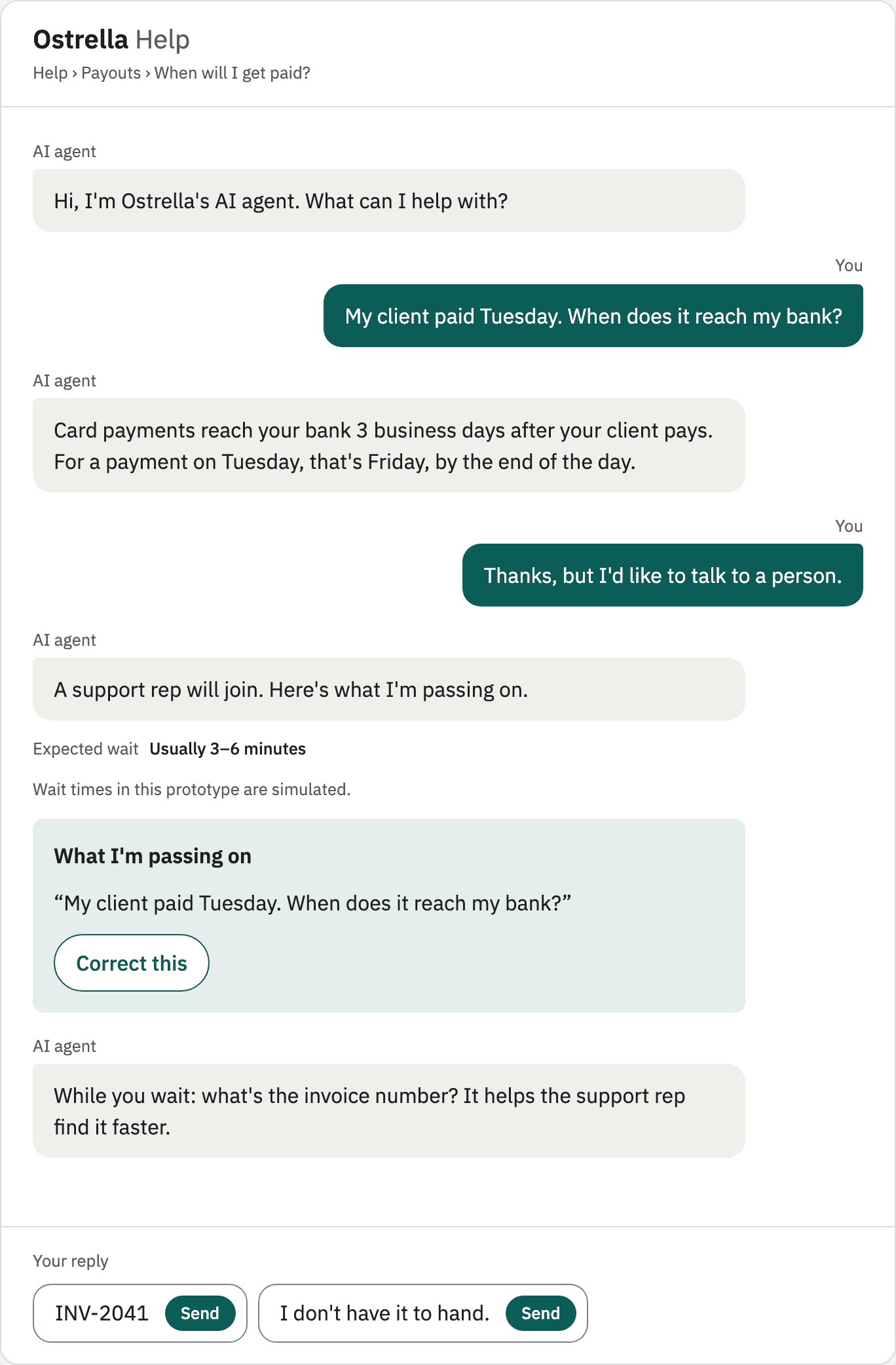
Asking for a person works the first time. The handoff starts at once. While the customer waits, the AI agent asks for one or two details, and never waits for the answers.
Trade-off Fewer conversations end with the AI agent alone.
The customer sees what's passed on, in their own words, and can correct it. No time limit, and it works by keyboard.
Trade-off One more thing to read, at the moment they're least patient.
The wait is stated honestly. A time range, no typing dots. After hours, the same message says no one's in, when they're back, and that the question is left as a note.
Trade-off An honest wait can be long. The design shows it; it can't fix staffing.
Wait times in this prototype are simulated.
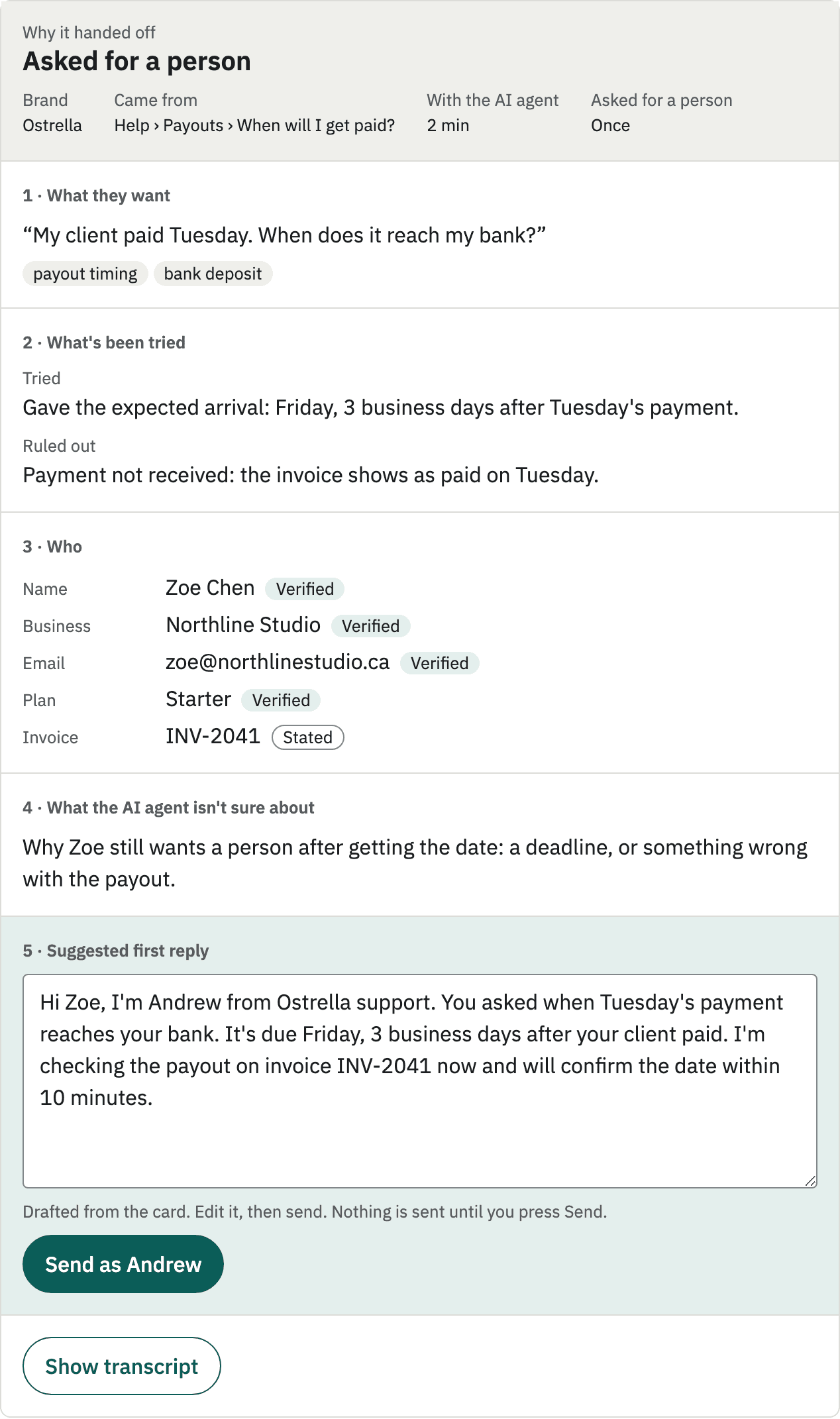
The support rep's side: the handoff card
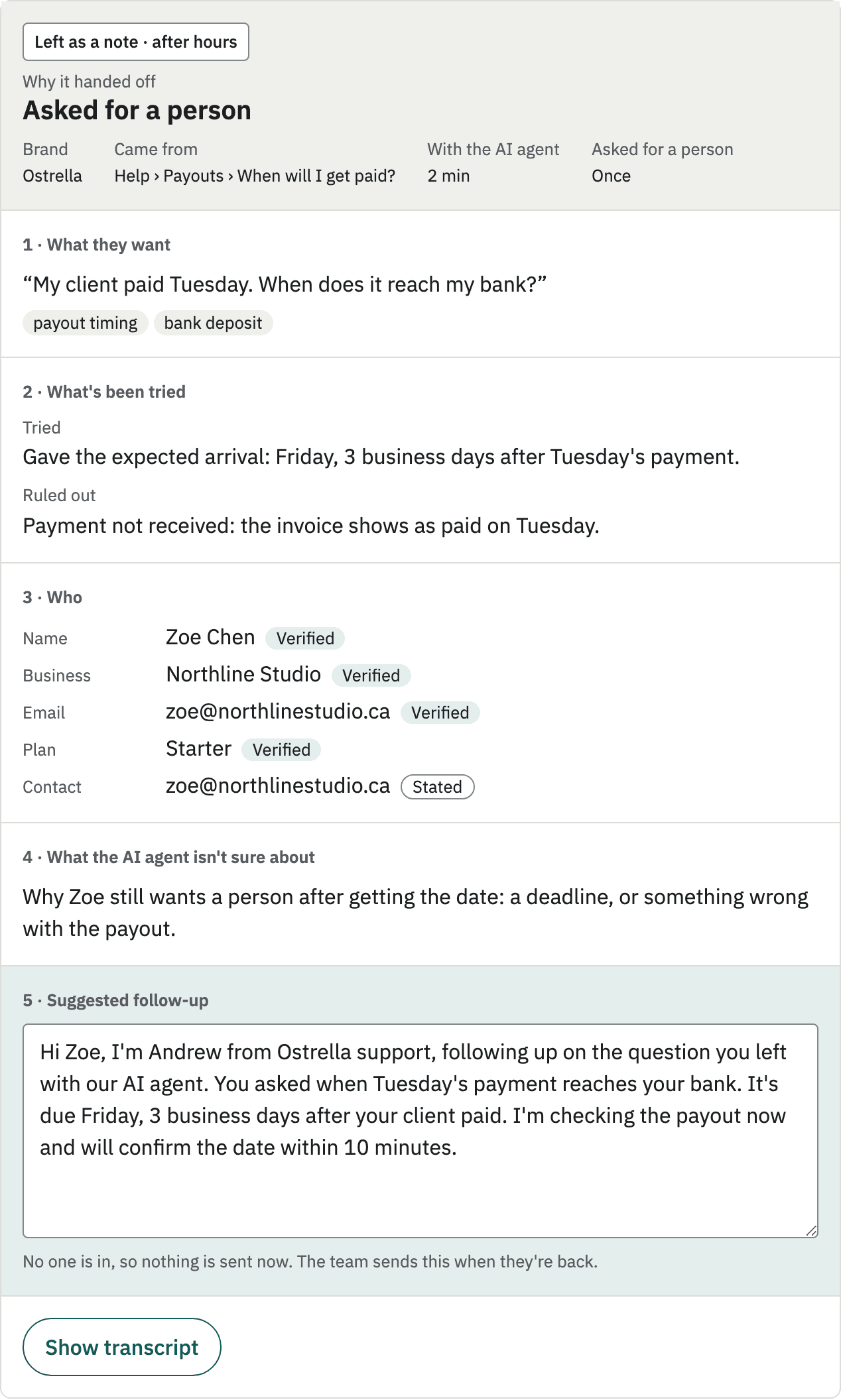
A header says why it handed off, as the specific trigger (“Disputed charge”). Then five fields:
- What they want, in their own words, quoted
- What's been tried, and what's been ruled out
- Who, each detail marked stated or verified
- What the AI agent isn't sure about, in one line, so the rep knows what to ask first
- Suggested first reply, drafted from the card
Five fields, not the transcript. The transcript stays one click away.
Trade-off A summary can be wrong, and the rep has to trust it.
The card says what the AI agent isn't sure about. “Not stated” beats a guess.
Trade-off Admitting doubt might lower trust in the card, or raise it. Testing decides.
The rep sends the first reply; it's never sent automatically. It reaches the customer already knowing the invoice and what was ruled out.
Trade-off Slower than auto-send. The rep stays accountable for the first human message.
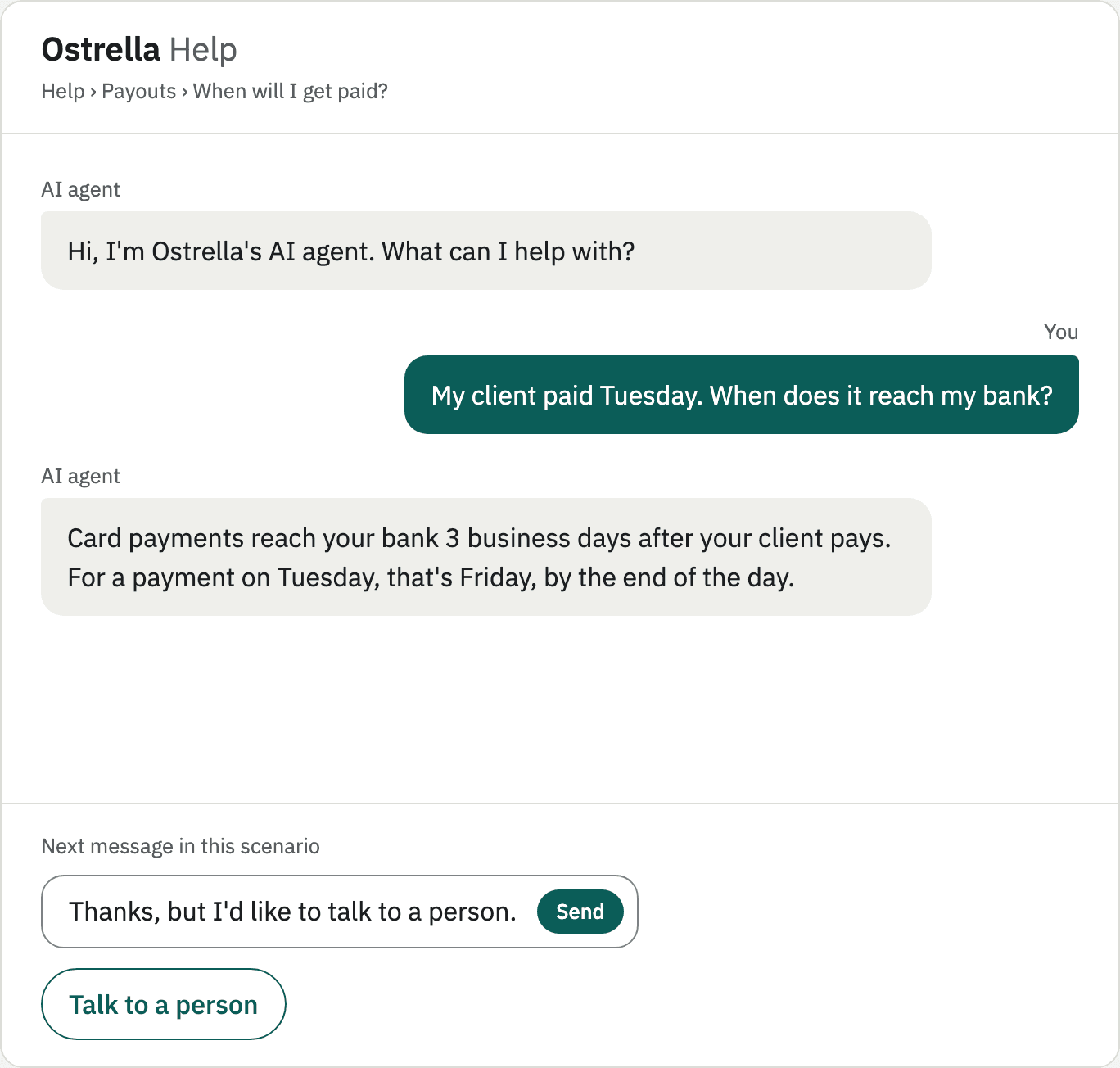
The ask. The AI agent has answered, and a person is one tap away.
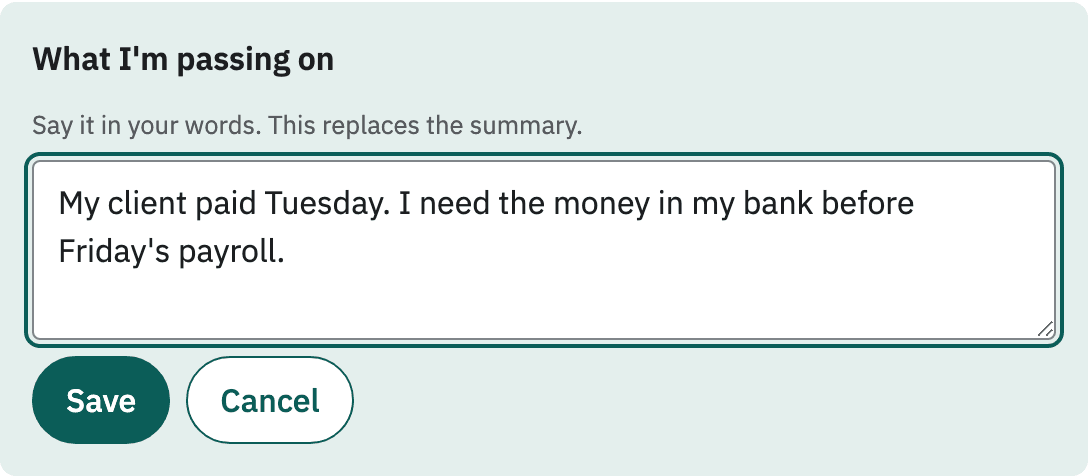
The correction. No time limit, and it works by keyboard.
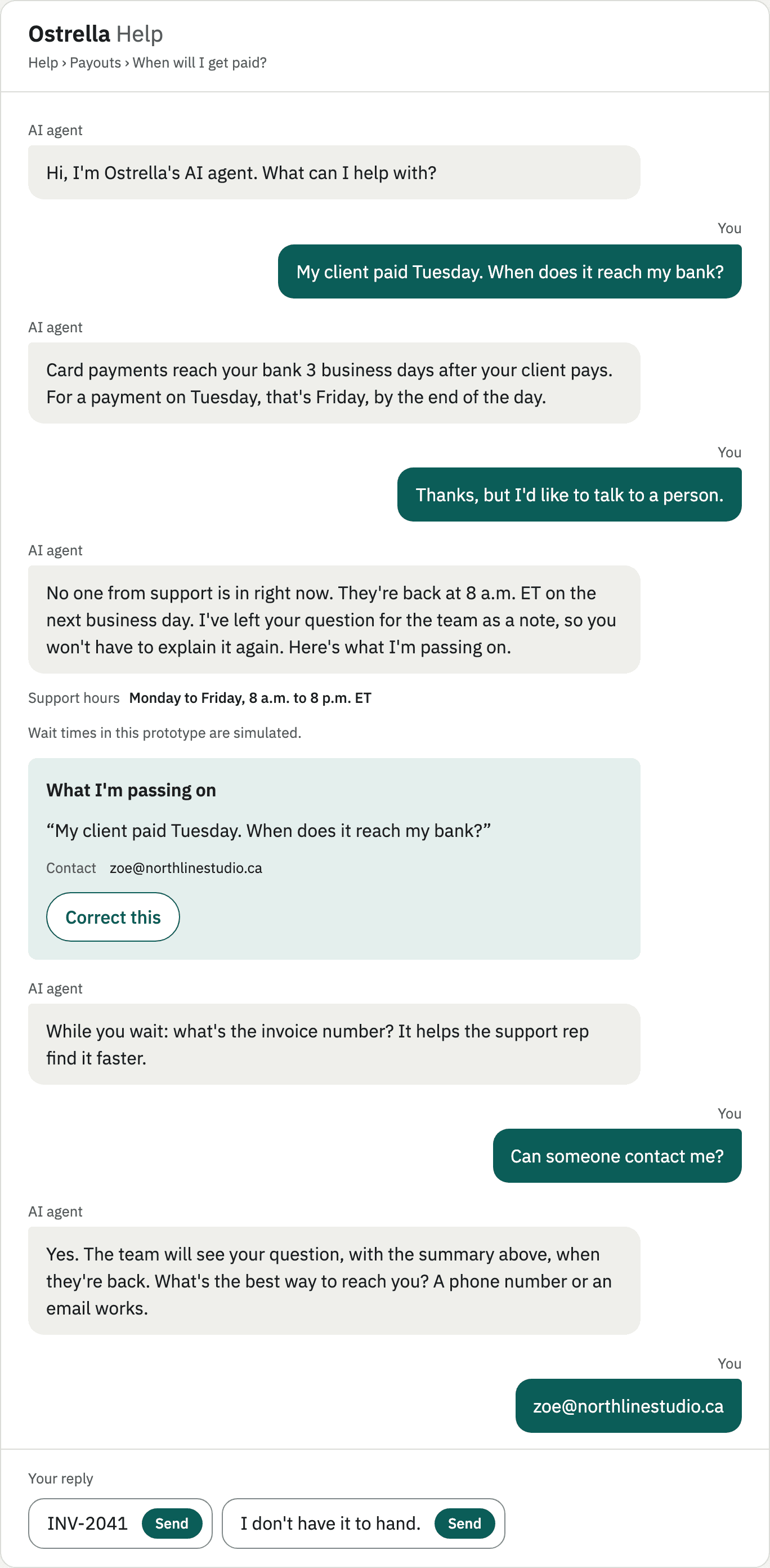
After hours. One message says no one is in, when they're back, and that the question is left as a note.
One card, two states
After hours, the card at the top of this page becomes a note for the team.
It keeps the same five fields, adds the contact details the customer left, and turns the reply into a follow-up for when the team is back. Nothing is sent after hours.
04 · When the AI agent steps back
Rules decide the cases that can't go wrong. The AI model decides the rest, and says why.
Checked in order. The first match wins.
The customer asks for a person. If no one is in, say so, and leave the card as a note.
Hand off nowA disputed or unexpected charge, security, or data loss.
Hand off nowNo close answer, or “that's not it”. Say why. The customer can decline.
Offer a personEverything else. The card says why in one sentence.
The AI model decides
Rules 1–3 are plain code, readable in one file. There's no frustration score: anger is a guess, and a customer who asks for a person always gets one.
Q keeps AI out of the pick, because an overwhelmed person trusts what they can check. Here the AI agent does the work, and rules draw the lines it can't cross. Why Q keeps AI out of the pick
05 · The words
Every line says what happens next. Nothing unknown is passed off as known.
The prototype's shared copy lives in one file, so the same moment always gets the same words. Four names, one meaning each:
- AI agent
- the bot on the help page.
- Support rep
- the person who takes over. Never called an agent, in the interface or the code.
- AI model
- what decides the cases no rule covers.
- Handoff card
- what the support rep reads first.
The customer never reads “rule”, “escalation” or “containment”. The card names the trigger (“Disputed charge”), never “rule 2”.
Six patterns, reused wherever the moment comes back
A support rep will join. Here’s what I’m passing on.
Name what’s passed on, before the support rep reads it. After a correction, the AI agent confirms it: “Summary updated. That’s what I’ll pass on.”
CustomerUsually 3–6 minutes
State the wait as a range, never as typing dots. When no one is in: who’s out, when they’re back, and what happens to the question. “I’ve left your question for the team as a note, so you won’t have to explain it again.”
CustomerWhile you wait: what’s the invoice number? It helps the support rep find it faster.
Ask while they wait, and say why. Not knowing is a fine answer: “No problem. The support rep will find it.”
CustomerI don’t think I’ve answered this. A support rep could look into it with you. Do you want me to bring one in?
Admit it, offer a person, and let them say no. A no keeps the way back open: “If you change your mind, choose Talk to a person below.”
CustomerNot stated
A blank says it’s blank. The card never fills a gap with a guess.
Support repNothing is sent until you press Send.
Say exactly when anything is sent. After hours: “No one is in, so nothing is sent now. The team sends this when they’re back.”
Support rep
06 · Where it breaks
Where it breaks, and what I'd measure first.
- A wrong summary travels with confidence. The customer's correction is the only guard.
- An honest wait can still be long. The design shows the wait; it can't shorten it. After hours, a note isn't a person.
- Cases no rule covers rest on the AI model's judgment, and nothing here measures how often it's right.
What I'd measure
Designed, not measured.
- How often the rep re-asks something the card already had
- Time from handoff to the rep's first useful reply
- How often customers correct the summary
- Repeat contacts about the same problem
Next: consulting without handing over. The AI agent keeps the conversation while a teammate decides. That's the next moment I'd design.